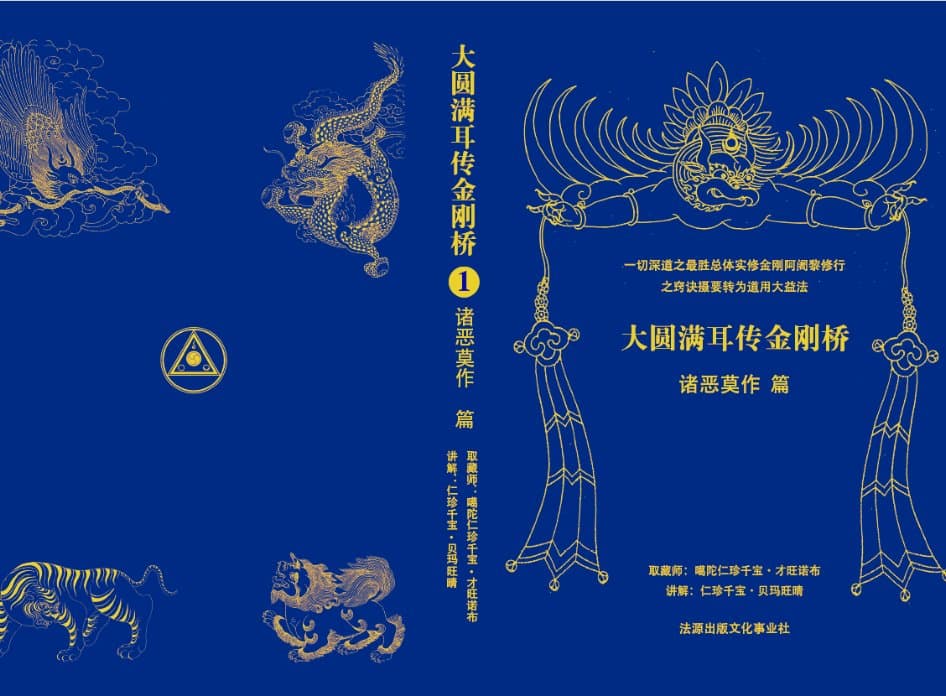
The Vajra Bridge of the Great Perfection(1): Do No Evil (Digital Version in Simplified Chinese)
Overview
Let us analyse any situation before we pray that all sentient beings may become free from all suffering and all its causes, both temporal and ultimate. How can we investigate any of the karma we have already accumulated, or our present karma, or our potential for future karma, or the karma of those for whom we are responsible, either now or in the future, or the karma of those who harm us? For repaying them, you may be practising both to help them and to overcome any karmic debts you have with them. Always remember to begin the bodhichitta dharma-nature in you.
I. Compassion and Wisdom Outlines the Path
The duty of every Buddhist is to listen and practise the Buddha's teachings as well as cultivate oneself on the path towards the awakening state of mind. This is the way of moving through dharma-nature in you. If there are any questions or omens with the dharma, and to connect with the Buddha-nature in you. You should be realising to the dharma no matter what feelings or problems occur.
II. Sutras, Vinaya and Abhidharma
Buddhism may be divided by the aspects of scriptures, as well as practices and conduct. From the practice's dharma, and from the theoretical terms is "teaching". The teaching is what? The teaching is the scriptures, including: Sutra Pitaka, Vinaya Pitaka, and Abhidharma Pitaka, collectively called the Tripitaka. Through learning and practising the Tripitaka, finally realising the content of sutra, vinaya and abhidharma, is the dharma realisation.
Teaching began with Tamas over sections in local languages. These are some ways of explaining the Buddha's teachings through both oral texts and scriptures. This is the realisation that leads through detailed explanation in order for living teachings are just some ways of expounding the dharma through details and conditions.
Clearly explained and categorised. Some parts have been taken out as notes. However, these and other theoretical discussions should not be compared with our basic features of Buddhist dharma:
The explanation analysis is very clear, each stage of practice terms explained very clearly. Repeated explanations, using various methods of repeated explanations, including theoretical explanations, or using metaphors and other methods, repeated until one must understand this dharma gate.
The theoretical part is very complete. If it is a sutra, it usually just tells a story, or just a practice method, it won't talk about much theory. But if it's a treatise, it will talk about a lot of theories and basis. For example, the content and basis of debates with non-Buddhists are explained very clearly and completely, making it impossible to break this theory.
Based on treatises to enter the scriptures, one can easily understand the meaning of scriptures. When we study a sutra, we may not necessarily be able to master it; but treatises are the gateway to wisdom. If we start from treatises, we can easily understand the meaning of scriptures. Moreover, when one gate is mastered, all dharmas are mastered. Therefore, most Buddhist academies in Tibet focus on teaching treatises, studying the five major treatises, and rarely teaching sutras.
III. Introduction to the Teaching Method
Generally treatises begin with discussing the author's excellence, whether it's the author, compiler, or treasure revealer, there will be a simple introduction, as well as the excellence of the teaching method, etc. This is to make readers and listeners develop joy and faith, especially to let everyone continue listening with eager interest. If you carefully read the Buddhist sutras, you will know that the Buddha repeatedly praised each sutra, praising each scripture as unique on earth and unmatched in heaven, as if each Buddhist scripture was the best, most excellent and most inconceivable. It's a bit like doing promotion and advertising, but this is not the Buddha "selling his own melons and praising himself", nor is it self-praise and criticism of others. From the Buddha's perspective there is no such need, but these methods are all for the benefit of sentient beings, for the sake of attracting and accepting sentient beings.
IV. What is the Vajra Bridge?
As for the general teachings on space (longde) of the Great Completion, this liturgy CQUCS is the "vajra bridge", and the reasons are as follows:
It uses the outer, inner, and secret tantric practices explained earlier to expound the essences of the Buddha's teachings, through the three vehicles and the nine siddhis; and Guru yoga is its root practice. Blessings from the guru is the lifeblood of the practice to accomplish the four dharmas of the Four Thoughts (four reversals) of:
- Turning the Mind to the Dharma
- Walking the Path of the Dharma
- Destroying Delusions in the Path
- Turning Illusions into Wisdom
As there are specific requirements for a text to qualify as a liturgy, such as the requirement that it must carry instructions on recitations and visualisations, the text Four-Themed Precious Garland that was written by Longchenpa at the sacred Kula Kangri is not classified as a liturgy.
Nevertheless, the path of the four dharmas (Turn the Mind to the Dharma; Walking the Path of the Dharma; Destroying Delusions in the Path; and Turning Illusions into Wisdom) have been the path taken by the Victorious Ones of the past and present, and it will also be the path taken by the future ones.
The Rigzin Tsewang Norbu had consolidated all the oral pith instructions and written them as a teaching. This is one of the reasons why this Vajra Bridge is such a supreme teaching.